
What Nobody Tells You About The People Quietly Holding Everything Together
The timeline is on fire. Three stakeholders want three different things. The developer just found a "small issue" that adds two weeks. And the client asks for a quick call.
Sound familiar? If you have been in project management for more than a few months or a few decades, you have lived this exact Thursday. The chaos is not the exception—it is the job. What separates good project managers from great ones is not whether they avoid the fire. It is how they behave while standing in the middle of it.
The Invisible Workload Nobody Sees
When a project goes well, the spotlight lands on the product, the engineers, the designers, the client. The project manager is rarely in the frame. That is, in many ways, the sign of a job done brilliantly. But it also means that the depth of what a project manager actually does remains largely unseen—even by the people they work most closely with.
On a typical Thursday, a project manager might be managing:
- Seven MS Teams group threads simultaneously, each requiring a different tone, a different audience, and a different level of urgency
- A roadmap that has already changed twice before the morning standup
- A budget conversation that everyone is quietly avoiding but somebody has to have
- A deadline that cannot move, attached to a scope that keeps expanding
- A developer who is blocked and not saying so loudly enough
- A stakeholder whose expectations are diverging from reality in real time
- A team that needs protecting from the noise above them so they can actually do their work
None of these tasks are in the job description. All of them are the job.
The Art of Staying Calm in a Burning Room
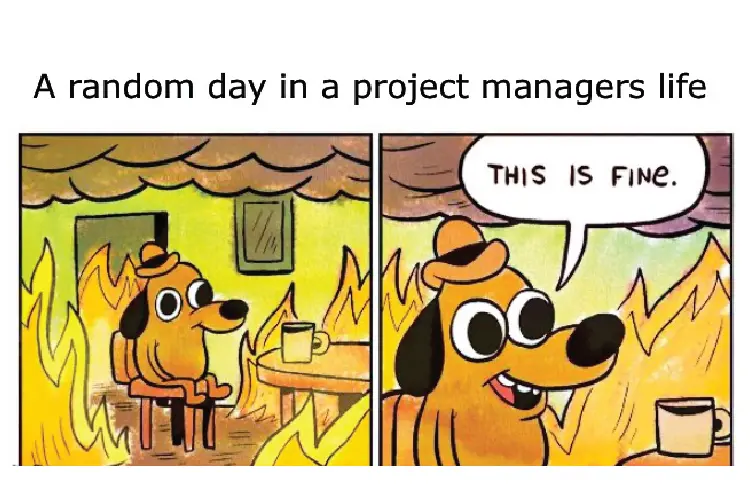
There is a meme that circulates every few months—a cartoon dog sitting at a table in a room full of flames, holding a cup of coffee, saying, “This is fine.” It became an internet joke, but project managers recognise something real in it. Not passivity. Not denial. But the deliberate, practised choice to remain steady while everything around you is escalating.
Emotional regulation is one of the most underrated skills in project management. When a developer drops a two-week delay into a standup, the team watches how the project manager responds. If the response is panic, panic spreads. If the response is frustration taken personally, trust erodes. If the response is calm, curious, and problem-oriented. When you respond with, “Okay, let us understand the full picture and work out our options”, the team stays functional.
This is not about suppressing genuine concern. It is about understanding that your reaction, as a project manager, is a signal to everyone else in the room about how seriously to panic. That is a significant responsibility. It is also something that can be developed deliberately over time.
Good project managers do one thing well. They stay calm while everything else burns. They translate chaos into clear next steps. They turn ten opinions into one plan.
Translation: The Core Skill
If you ever had to identify the single most important skill in project management, it might be this: translation. The ability to take the language of the business and turn it into something a developer can act on. The ability to take technical complexity and turn it into something a client can understand. The ability to take ten conflicting stakeholder opinions and distil them into one coherent direction.
This translation work is constant and invisible. It happens in every meeting, every email, every conversation where two parties are talking past each other. The project manager is the interpreter standing in the middle, reformulating, reframing, clarifying, and making it look effortless.
Consider what happens during a typical stakeholder alignment session. The marketing team wants launch by end of quarter. The technology team is flagging technical debt that needs addressing first. The finance team wants the budget reduced by fifteen percent. Each of these positions is internally logical. Each represents a real priority. But they cannot all be true at the same time.
A good project manager does not just take notes and circulate a meeting summary. They synthesise. They identify where the actual conflicts lie, where there is more flexibility than people are admitting, and what trade-offs are actually on the table. They shape a recommendation that each party can accept, not because they got everything they wanted, but because the reasoning is clear and the process was fair.
This is not a skill taught in a certification course. It develops through experience, pattern recognition, and a genuine interest in understanding what people actually need, as opposed to what they say they want.
The Budget Conversation Nobody Wants to Have
Every project has a money problem at some point. A scope that crept beyond the original estimate. A line item that was under costed. An unexpected dependency that has now become critical. The budget conversation is one of the most uncomfortable interactions in professional life, and project managers have it more often than almost anyone else.
What makes it hard is not just the numbers. It is the relationships involved. It is the fact that raising a budget concern can feel like admitting a mistake, or creating a problem, or making someone’s day significantly worse. It is the knowledge that the person on the other end of the conversation did not budget for this, either, and they are going to have their own difficult conversation upwards as a result of yours.
Strong project managers approach budget conversations with a combination of transparency, data, and options. They do not arrive with just a problem. They arrive with context: here is what has changed, here is why, here is the impact, and they arrive with choices. “Here are three ways we can respond. Here are the trade-offs of each. What would you like to do?”
That shift from problem-presenter to options-provider changes the entire dynamic of the conversation. It does not make the news good. But it makes the path forward navigable.
Protecting the Team
One of the most important things a project manager does is also one of the least visible: absorbing the noise from above so the team below can focus. Stakeholder pressure, changing priorities, conflicting executive opinions, late-stage scope changes — all of this lands on the project manager first. A big part of the role is deciding how much of that turbulence needs to reach the team, and how it should be framed when it does.
This is not about filtering reality dishonestly. It is about pacing, context, and framing. A developer who is three days from completing a complex feature does not necessarily need to know, in that moment, that a stakeholder has raised concerns about the overall product direction. That conversation may be important, and will need to happen, but the timing matters. Introducing anxiety at the wrong moment does not serve the work.
Great project managers act as a kind of organisational shock absorber. They take the jarring, often chaotic input from the outside world and convert it into something stable and actionable that the team can work with. This requires both situational awareness and emotional intelligence. It requires knowing your team, who handles uncertainty well, who needs more structure, who will rise to a challenge and who will spiral if given too much ambiguity at once.
It also requires trust. Teams follow calm, consistent project managers into hard situations because they have learned, over time, that the project manager will not throw them into chaos unnecessarily, and will not hide things that genuinely matter.
What the "Small Issue" Really Means
Every project manager who has spent time working with developers has heard the phrase “small issue” and learned, quickly, that it is rarely small. This is not a criticism of developers—it is a feature of how technical work unfolds. Something that looks contained at the surface often connects to something structural beneath it. The honest answer to “how long will this take?” is frequently “I do not know yet.”
The project manager’s job in these moments is not to push back on the complexity, to minimise it, or to demand certainty where there is none. It is to ask the right questions—what do we know, what do we not know yet, what is the worst-case scenario, what can we do to learn faster—and to take that information into the schedule and the stakeholder relationships with honesty and a plan.
Two weeks added to a timeline is a problem. But it is a manageable problem. The unmanageable version is finding out about those two weeks two days before the original deadline, when there is no time to adjust, no time to communicate, no time to make choices. Good project managers create the conditions in which people feel safe to surface bad news early, because they have demonstrated, over and over, that early bad news is treated as information, not as a failure.
The Quiet Infrastructure of Every Good Project
Think about the last project you were part of that went reasonably well. Now try to identify exactly what made it work. Chances are, some of it was clear—strong design, solid engineering, a good brief. But some of it, if you trace it back, will lead you to a set of decisions, conversations, and interventions that happened just out of view.
The kickoff meeting that established clear roles before confusion had a chance to set in. The risk register that flagged the dependency issue three weeks before it would have become a crisis. The retrospective that surfaced the communication problem and gave it a name before resentment built up around it. The conversation with the client that reset expectations before they calcified into disappointment.
These are not dramatic moments. They do not make it into the case study or the launch post. But they are the infrastructure that holds everything else up. And the project manager is, more often than not, the one who built and maintained that infrastructure, quietly, consistently, without waiting to be asked.
A Note to Everyone Who Works With a Project Manager
If you have a good project manager on your team, it is worth pausing for a moment to recognise what that actually means. It means someone is thinking about the things that would go wrong if nobody thought about them. It means someone is having the difficult conversations so that you do not have to. It means the coordination that looks effortless has, in fact, been worked at, repeatedly, in the background.
It means when you get a clear brief, that clarity did not arrive by accident. When a deadline shifted and nobody panicked, that stability was held. When a stakeholder concern got resolved before it reached you, someone managed that. When the sprint started with the right priorities, somebody made sure the noise did not win.
They are quietly holding the whole operation together.
Tell them. Not because they need external validation to keep going—the good ones do not. But because the work of holding things together is hard, and the invisibility of doing it well is one of its more exhausting features. A simple acknowledgement goes further than most people realise.
The Real Thursday
By end of day on that random Thursday, most of the fires will be lower. Not out, they rarely go fully out. But lower. The three stakeholders will have, somehow, arrived at a version of the same plan. The two-week delay will have been communicated clearly and absorbed into a revised schedule. The client call will have happened, and the client will leave it feeling heard rather than alarmed.
None of that will appear in a release note or a product announcement. But it will have been the difference between a project that held together and one that fractured. The person responsible for that difference will already be looking at Friday’s calendar, working out what needs to happen before the week ends so that next Thursday is marginally less on fire.
That is the job. That is the craft. And if you do it—if you are that person—you should know that the work matters, even when it goes unnoticed. Especially then.


CAPM/PMP Exam Prep & Study Group
AgileAdmiral – Weekly Project Management Newsletter. Follow me on LinkedIn
Or join my weekly project management newsletter to learn more about PM career path. LinkedIn/ Substack
Gabor Stramb has over 14 years of experience leading projects in Energy (oil & gas) and Telecommunication industry. Gabor founded Projectcertifications.com in 2021, which help project aspirants to pass CAPM/PMP exam. His main vehicle in this area is the weekly study group. Working with close partnership with PMI UK chapter.
Gabor has a master’s degree in project management and certification from George Washington University.