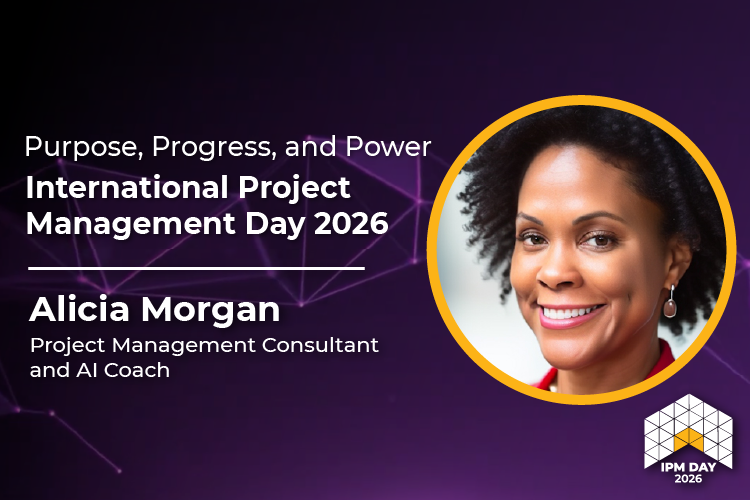
An Interview with Alicia Morgan, presenter at IPM Day 2026 and Lori Milhaven, Executive Vice President at IIL.
July 13, 2026
Every conversation about AI and project management starts in the same place: automation. Faster reports. Smarter dashboards. One less status meeting.
Alicia Morgan wants to talk about something else entirely. For her, the real story is not what AI takes off a project manager’s plate. It is what it hands back. Time. Capacity. The bandwidth to think. What you do with that bandwidth is where careers get made or quietly stall out.
Across a career in aerospace, manufacturing, education, and digital transformation, Alicia has watched wave after wave of “the tools are changing everything” moments. Her message is consistent: tools create possibilities, but judgment determines whether possibilities deliver value.
Ahead of her session at IPM Day 2026, we asked Alicia where the real line sits between AI-accelerated work and human accountability, and why the project managers who will thrive are those who combine AI capabilities with strong judgment and sound decision-making.
Lori: Let’s talk about the role that’s changing. AI is reshaping how work gets done at every level, but project managers are feeling it in specific ways. In your experience, what’s the biggest misconception project managers have about what AI means for their role, and what’s at stake if they do not adapt?
Alicia: The biggest misconception is that AI is only a productivity tool. AI can automate meeting notes, status reports, and administrative tasks. Those efficiencies matter, but they are only part of the story.
The larger shift is in how project managers create business value. AI can accelerate execution, but the greater advantage comes from the strategic capacity it recovers. That capacity can be redirected toward stakeholder alignment, decision-making, risk management, and organizational priorities.
Project managers who develop AI fluency will be better positioned to connect delivery with business outcomes. Their influence will grow because they can translate technical capability into measurable value.
The role is not disappearing. The role is evolving. The opportunity belongs to project managers who evolve with it.
Lori: The line between AI and human judgment. You talk about distinguishing where AI can accelerate work from where human judgment is essential. Where is that line and how do you know when a team has crossed it in the wrong direction?
Alicia: The line is accountability. AI can accelerate research, analysis, content development, and workflow execution. Those capabilities can improve speed and efficiency across a project environment.
Human judgment remains essential when decisions affect business outcomes, stakeholder relationships, organizational risk, governance, or reputation. Accountability cannot be delegated to a model.
Teams are at greater risk when speed takes priority over context. Institutional knowledge, stakeholder needs, and organizational realities must get higher attention than system outputs.
Strong teams use AI to inform decisions. Human leaders remain responsible for validating context, weighing tradeoffs, and owning the outcome.
Lori: The new leadership edge. You define AI fluency, judgment, and orchestration as the emerging edge for project managers. Which area or areas do most project managers underestimate, and what does it look like when someone gets it right?
Alicia: Judgment is the most underestimated capability because it’s harder to measure. AI fluency often receives the most attention because the tools are visible and constantly changing.
Throughout the transformation projects I’ve led, one lesson stayed with me. Technology creates possibilities, but judgment is what turns those possibilities into business value. Strong judgment brings clarity to complex situations. It helps teams recognize risk earlier, understand implications more fully, and make decisions that align with business objectives.
Project managers who develop this skill build confidence. They help teams move forward with greater focus, stronger alignment, and better outcomes.
Lori: The orchestration challenge. Orchestrating people, workflows, and AI-enabled work requires a different skill than traditional project coordination. What’s the biggest challenge for experienced project managers as they make this shift from being the ones who hold everything together?
Alicia: The hardest part is redefining control. Many experienced project managers built their careers through visibility, coordination, and direct oversight. Those skills remain important, but the environment has become more complex.
Modern project leadership requires orchestration across people, processes, technology, and AI-enabled workflows. Success depends on clear ownership, good governance, effective communication, and well-defined decision pathways.
The role is becoming less about managing every activity and more about creating conditions for successful outcomes. The strongest project managers deliver immediate business value while building capabilities that organizations can continue to scale. They create both short-term ROI and long-term value.
Lori: The human element. With so much focus on AI capabilities, there’s a real risk of people feeling sidelined. How do you keep teams meaningfully involved and motivated when AI is doing more of the work around them?
Alicia: Meaningful AI involvement starts with clarity. People remain engaged when they understand how their expertise, judgment, and experience contribute to outcomes. AI can accelerate work, but it does not replace accountability, collaboration, or trust.
The strongest teams use AI to reduce friction. Routine work becomes more efficient, creating more time for problem-solving, stakeholder engagement, and decision-making.
Successful AI adoption strengthens people, not just processes. Organizations create the greatest value when AI enhances human capability, preserves institutional knowledge, and gives people time to focus on collaboration, innovation, and delivering better business outcomes.
Lori: You have shared why human judgment remains a project manager’s greatest advantage in this age of AI. What are you hoping attendees will take away from your session this November?
Alicia: One takeaway I hope attendees leave with is your professional judgment and experience are among your greatest assets, so do not let them disappear.
Project artifacts capture more than deliverables. They reflect decisions, tradeoffs, lessons learned, and problem-solving approaches. While it is essential to always respect organizational and client intellectual property, you can still document the insights and methods you gained throughout your careers.
As AI becomes integrated into project work, those experiences become increasingly valuable. They help you recognize patterns, evaluate options, and you need this for decision-making. Tools will change, but your accumulated judgment and experience remain among your most valuable strategic assets.
Alicia Morgan’s message lands on a simple but important truth: the tools will keep changing, but responsibility remains with us. AI can accelerate the work, but it cannot own the outcome, read a room, or preserve the lessons teams have learned through experience.
The advantage Alicia wants project managers to take away is not a better prompt, but sharper judgment and a commitment preserving what they know before the next wave of change comes.
Catch Alicia Morgan’s full session at IPM Day on November 5, 2026, where she will dig deeper into orchestration, judgment, and what it really takes to lead in an AI-enabled project environment!
Alicia M. Morgan
Alicia Morgan, PMP, is a TEDx speaker, project and innovation leader, and AI coach with 15+ years leading enterprise portfolios across Fortune 500 aerospace, education, nonprofit, and traditional environments. She helps bridge technical and non-technical teams through governance, change leadership, and execution while guiding human-centered AI modernization.