
By The IIL Team
January 15, 2026
Introduction: The Unseen Revolution in Project Management
But in the relentless VUCA environment — accelerated by global shocks like the COVID-19 pandemic — that playbook has been torn to shreds. The core assumptions that defined project success for a generation are no longer valid.
This article explores five of the most impactful and surprising shifts in modern project management, drawing on key insights from renowned expert Dr. Harold Kerzner to illuminate the new principles that define success today.
1. You're No Longer a Project Manager—You're a Business Manager
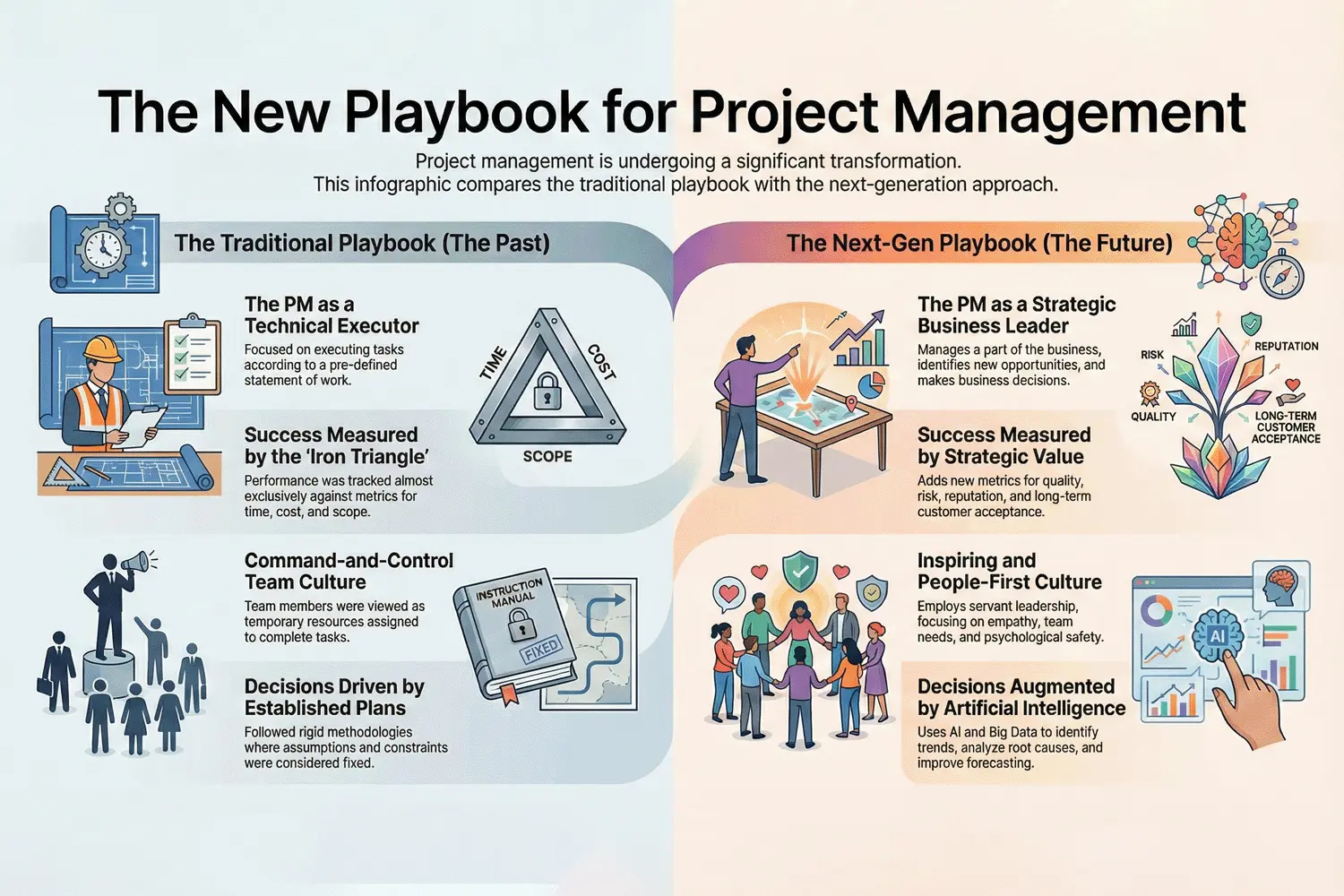
The most fundamental shift is in the project manager’s core identity. The role has evolved from that of a tactical implementer, tasked with simply executing a pre-defined plan, to that of a strategic business partner. Today’s project managers are expected to manage “part of a business,” not just an isolated project.
This expanded responsibility includes identifying new business opportunities that may arise during the project’s lifecycle, rather than being confined to the original statement of work. It is a profound change in expectation, elevating the project manager from a coordinator to a business decision-maker.
If you’re a project manager today, you’re no longer managing a project. Let me repeat that. Project managers today are no longer managing projects. They’re managing part of a business. You have become a business manager and we’re expecting you to make business decisions as well as project-based decisions.
This elevation is critical: it means project managers are now directly accountable for delivering competitive advantage, not just deliverables. Their success is measured by the project’s contribution to market share, revenue growth, or strategic positioning, tying their role directly to the organization’s bottom line.
2. "Over Budget and Behind Schedule" Isn't the Problem
It’s a classic project status update that causes anxiety in any boardroom: “We’re over budget and behind schedule.” Traditionally, these issues have been viewed as the core problems to be solved. However, the next generation of project management reframes this thinking entirely. These are merely symptoms, not the actual problem.
Modern project management demands a deeper analysis to uncover the root cause driving these surface-level issues.
How many times have I heard people come over to me and say, “I have a problem. I’m over budget and behind schedule.” When they say that, I look at them and I say, “You’re telling me the symptoms, not the problem. What’s the root cause of the problem?”
This mindset shift is critical. Focusing on symptoms leads to temporary fixes, like cutting corners to save money or adding resources to speed up a schedule, which often fail to address the underlying issue. Identifying the root cause—be it poor risk management, flawed initial assumptions, or changing environmental factors—allows for real, lasting solutions that prevent the same symptoms from reappearing.
3. Success Might Only Be Visible Years After Your Project Is "Done"
The traditional definition of project success has been a simple checklist measured at the finish line: was it completed on time, within budget, and to the original scope? This view is now dangerously shortsighted, especially for strategic and innovation-focused projects.
The new reality is that a project’s true success may not be measurable until two or three years after it is formally “over.” The ultimate metric is often long-term value, such as “customer acceptance in the marketplace.” A project can meet every one of the triple constraints and still fail to deliver lasting business value if the market doesn’t embrace the outcome.
Furthermore, there is no longer a single, universal method for measuring success. Every project can have a different set of criteria, moving beyond the simple triple constraint to include new metrics for quality, safety, risk, ethical conduct, reputation, and image. This fundamental change forces a shift in focus from short-term outputs (the finished product) to long-term outcomes (the sustained business value it creates), ensuring projects are true instruments of enduring business strategy.
4. Knowing When to Quit Is a Critical Skill
Historically, organizations have been notoriously poor at terminating failing projects. Fueled by sunk costs and the hope for a last-minute miracle, they often allow struggling initiatives to consume valuable resources long past the point of viability.
The modern approach counters this tendency by treating the decision to “pull the plug” as a strategic competency, not a sign of failure. To enable this, organizations are providing project managers with clear, predefined “exit criteria” at the very beginning of a project. This criteria, established by governance, defines precisely what constitutes failure and gives the team a clear signal for when to stop.
Examples of such exit criteria include:
- The return on investment will occur too late.
- The competition is too stiff and not worth the risks.
- The product cannot be supported by existing production facilities.
- The product and the service will not be purchased by our existing customer base.
This approach transforms failure from a career-ending event into a calculated business decision. It conserves resources, minimizes losses, and allows the organization to pivot its energy and capital toward more promising ventures with greater agility.
5. Your Most Important Job Is Cultivating Culture, Not Control
The workplace phenomenon of “quiet quitting” has brought company culture to the forefront of business conversations. In 2021 alone, nearly 48 million Americans left their jobs, many because their working environment wasn’t satisfying their needs. This highlights a massive shift in what employees expect from their work—and project management is at the heart of this change.
This is a stark departure from the historical view, where, as Dr. Kerzner notes from his own experience, the PM’s job was to “remove those people from my project as quickly as possible” to control costs. The new paradigm focuses on building a cooperative and psychologically safe culture. Project managers must now demonstrate a genuine concern for the needs and expectations of their team members. This means creating an environment where people feel safe to express ideas, take calculated risks, and receive constructive—not personal—criticism.
Crucially, this project culture must align with the overall corporate culture. Team members need a clear “line of sight” to the company’s strategic objectives, understanding how their work contributes to the bigger picture. In an era where talent retention is a primary competitive advantage, the project manager’s role as a servant leader and culture-builder has become more critical to success than the old command-and-control approach.
Conclusion: Leading the Future, Not Just Managing the Plan
The transformation is undeniable. The modern project manager is no longer a mere custodian of a plan but a business leader, a root-cause analyst, a long-term value strategist, a decisive terminator of failing initiatives, and a vital cultivator of talent-retaining culture. These are not just new rules; they represent a new professional identity.
As these powerful shifts redefine the landscape, which of these new rules will you implement first to not just manage your next project, but to truly lead change?
Additional Resources
For more information on the evolution of Project Management, view these resources:
Free Webinar | The Next Generation of Project Management, with Dr. Harold Kerzner