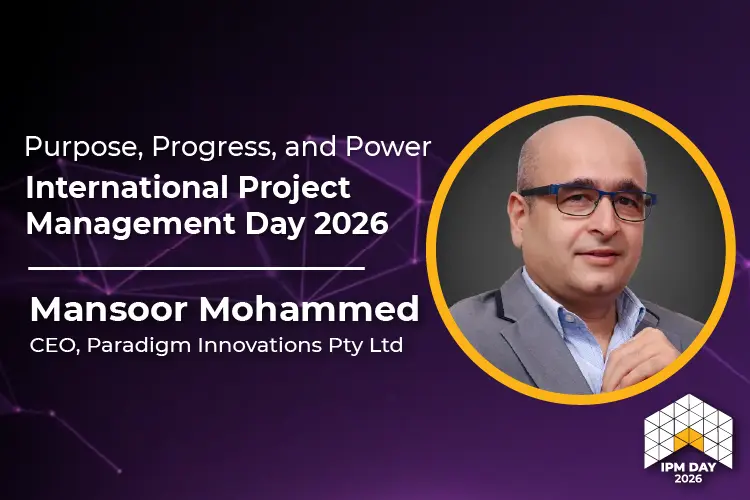
Speaker Spotlight – Mansoor Mohammed
June 11, 2026
What if governance isn’t the obstacle to agility, but its greatest enabler? Forward-thinking leaders are redefining governance to accelerate innovation, empower teams, and deliver greater value. Mansoor Mohammed, speaker at IPM Day 2026, introduces Agile Governance Ambidexterity, a framework that positions governance as a value-enabling capability rather than a control-centric function.
1. The Big Reframe
A lot of leaders have been conditioned to think of governance as a control mechanism—approvals, stage gates, reporting, and compliance. Agile, on the other hand, is often associated with speed, flexibility, and autonomy. The problem is that organisations frequently treat these as competing forces when, in reality, they are complementary.
My research introduced the concept of Governance Ambidexterity, which is the ability of organisations to balance control and adaptability simultaneously. Rather than choosing between governance and agility, successful organisations learn to apply both in the right measure and at the right time.
Governance should not be about controlling people; it should be about enabling value delivery while managing risk. When governance provides clear strategic direction, transparent decision-making, and appropriate guardrails, Agile teams can move faster, not slower. The question is no longer “How much governance do we need?”, but rather “What type of governance best supports the outcomes we are trying to achieve?”
2. The Leadership Factor
The most difficult habit for senior leaders to break is the belief that being accountable means personally controlling decisions.
Many leaders have built successful careers by being the smartest person in the room, making critical decisions, and solving problems directly. However, Agile environments require a different leadership approach. Leaders must shift from directing work to enabling work.
This requires trust, psychological safety, and distributed decision-making. The challenge is that trust often feels riskier than control. Yet organisations that consistently outperform are those where leaders create environments in which teams can experiment, learn, and adapt without fear of blame.
The leadership shift is not about giving up authority; it is about using authority differently. Instead of asking, “How do I control this?” effective leaders ask, “How do I create the conditions for success?”
3. Making It Real
Good governance is often invisible because it works in the background.
Imagine a project team delivering a new digital customer experience. Rather than waiting weeks for steering committee approvals, the organisation establishes clear strategic objectives, decision boundaries, risk thresholds, and value measures up front.
Teams are empowered to make operational decisions within those guardrails. Leaders focus on outcomes rather than activities. Governance conversations shift from status reporting to value realisation, emerging risks, customer feedback, and strategic alignment.
In practice, this means shorter decision cycles, fewer approval layers, greater transparency, and continuous learning. Teams spend less time producing reports and more time delivering outcomes. Governance becomes an accelerator of value rather than an administrative burden.
4. Scaling the Challenge
Many organisations successfully implement Agile at the team level but struggle when scaling because they simply replace old bureaucracy with new bureaucracy. The answer is not more governance; it is smarter governance.
Organisations need alignment around strategy, priorities, value streams, and decision-making principles rather than rigid processes. My research found that organisations that scale successfully focus on creating a shared governance framework while allowing flexibility in how teams operate.
This means standardising outcomes rather than standardising every activity. Teams should share common objectives, measures, and governance principles while retaining autonomy over how work is executed.
The organisations that succeed at scale are those that can maintain strategic coherence while encouraging local adaptability. That is the essence of governance ambidexterity.
5. The First Step
You do not need to be the CEO to create change.
One practical action anyone can take this week is to identify a recurring approval, meeting, or governance activity that people participate in simply because “that is how we have always done it.”
Ask three simple questions:
- What value does this activity create?
- What risk is it helping us manage?
- Could we achieve the same outcome with less effort or faster feedback?
These questions often reveal governance practices that no longer serve their original purpose.
Transformation rarely starts with a major organisational redesign. It starts with curiosity, conversation, and small improvements that challenge outdated assumptions.
Every organisation has opportunities to simplify governance while strengthening accountability and value delivery.
The future belongs to organisations that can be both disciplined and adaptive, controlled and innovative, governed and agile. That is the journey toward Governance Ambidexterity.
Mansoor Mohammed will be presenting “The Governance Revolution: Breaking the Paradox Between Control and Agility” at International Project Management Day 2026. View his full presentation details here.

Mansoor Mohammed is an Enterprise Agile Coach and PMO leader, with over 25 years of international experience spanning government, defense, higher education, and technology. A certified PgMP, PfMP, PMP, and SAFe SPC, Mansoor has led enterprise PMOs, implemented tailored Predictive (Waterfall) and Adaptive (Agile) frameworks at scale, and built Centres of Excellence that elevate organisational maturity.