By Lori Milhaven, EVP, IIL
October 19, 2026
What happens when the thing you delivered keeps changing after you deliver it? AI agents are breaking one of project management’s oldest assumptions: that a project has a clear finish line. Ahead of IPM Day 2026, I asked Sarbaja Adhikari, who has worked as both a software engineer and a product manager, how PMs can plan, budget and lead when launch is only the beginning.
Lori: The definition of done is dead. If an AI agent keeps learning after launch, when is the project finished? How do you close out something that never stops changing?
Sarbaja: With AI agents, I see launch as an important milestone, but not necessarily the end of the work. We need to understand how the system performs in the real world and whether it is delivering the value we expected. For me, a project is ready to close when we have achieved our initial goals and have a clear plan for what happens next. The system may continue to evolve, but the project still needs a clear endpoint and ownership after handover.
Lori: Launch is the starting line. You argue optimization in production should be a core requirement, not a post-launch afterthought. What does that look like in a project plan, and how do you get budget for work most sponsors assume is already done?
Sarbaja: We need to consider this from the beginning, not after the system launches. When creating a project plan, we should account for the time, resources, and support needed to evaluate performance and make improvements. When discussing the budget with sponsors, I would connect that work to business outcomes. To keep the system delivering value, we need to invest in understanding what’s working, what is not, and where improvements are needed.
Lori: Requirements will not sit still. Traditional PM is built on predictability. AI agents bring uncertainty and shifting requirements. Which classic PM practices still hold up, and which ones should project managers drop?
Lori: From builder to orchestrator. You have worked as both a software engineer and a product manager. What is the biggest mindset shift for a PM moving from delivering software to orchestrating intelligent systems?
Sarbaja: Coming from a software engineering background and moving into product and project management has taught me to look beyond whether something works technically. We also need to understand the problem we are solving, the people using the system, and the business value we are trying to create. With AI agents, bringing these perspectives together becomes even more important because the system continues to evolve after launch. The PM helps connect the different teams and keeps their work focused on a shared outcome.
Lori: Ambiguity is the job now. When business goals shift mid-stream and the system itself is evolving, how do you keep cross-functional teams aligned without constant whiplash?
Sarbaja: Alignment starts with making sure everyone understands the goal, not just the tasks they are responsible for. When priorities change, we need to explain why, what the change means, and how it affects the team’s work. Not every new piece of information should trigger a complete change in direction. The PM needs to help the team distinguish between changes that genuinely matter and those that do not, while keeping communication open and priorities clear.
The project may close. The system keeps learning. The PMs who plan for that will lead.
Catch Sarbaja Adhikari’s on-demand video presentation, AI Agents in Project Management: Building and Delivering Intelligent Systems in Evolving Delivery Environments at IPM Day 2026, starting Nov. 5.
Executive Vice President at International Institute for Learning (IIL)
Our deepest purpose is to enable growth and success of individuals, teams and organizations with long-lasting, high quality learning in a technology-driven world. Lori is honored to have been with IIL over 30 years, and to make it her mission to focus on continuous improvement, client driven success and to go above and beyond to meet expectations.

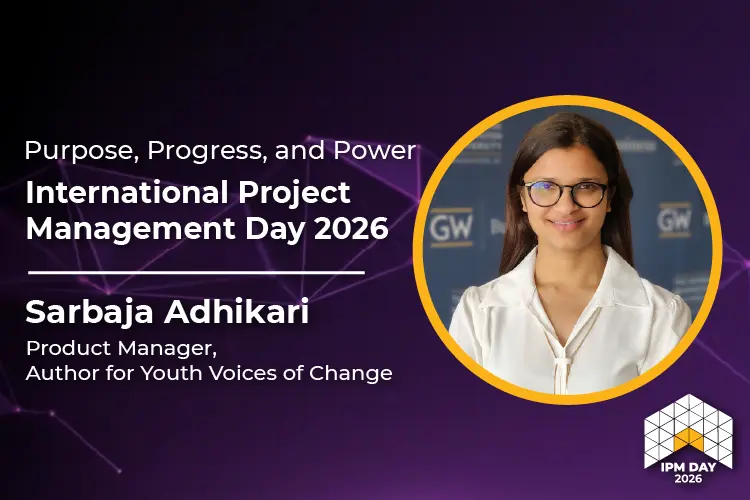
Sarbaja Adhikari
Product Manager, and Author for Youth Voices of Change
Sarbaja Adhikari is a Product Manager and former Software Engineer focused on building impactful, data-driven solutions. She holds a Master’s degree in Project Management from George Washington University and was honored as a Project Management Institute (PMI) scholar in both 2023 and 2024.
She has contributed as a Youth Leadership Mentor, Reviewer, and Author for PM Ready’s “Youth Voices of Change,” supporting and guiding emerging project managers. She has also served as a Judging Committee Member for the PMI PMO of the Year Awards 2025 and continues to support the initiative in 2026.
She was also a speaker at International Project Management (IPM) Day 2025, where she presented “From Metrics to Meaning: Storytelling EVM Insights with Power BI,” focusing on transforming EVM data into actionable stories for project managers.
Recognized as a Top Voice on LinkedIn, she shares insights on project management, agile, product development, and risk management. She also writes on Medium, where she shares her perspectives and learnings with a broader audience. She is also an upcoming contributing author for the 5th edition of Project Management Metrics, KPIs, and Dashboards.