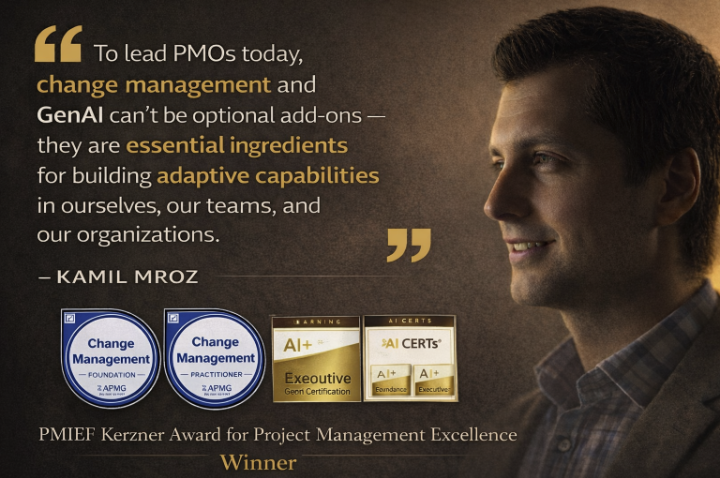
By Kamil Mroz, 2024 winner of the PMI Kerzner Award for Project Management
February 11, 2026
“Change is the only constant.”
Heraclitus said it more than two thousand years ago… and yet it may be the most relevant statement for today’s project and PMO leaders.
We are living through a moment where two forces are converging at speed: the acceleration of technological capability and the human challenge of change. Increasingly, the success of our projects (and our organizations) depends on how well we can navigate both.

From Delivery Managers to Capability Builders
For decades, project leaders were primarily judged on execution: scope, schedule, budget, delivery. Those fundamentals still matter. But they are no longer sufficient.
Today’s PMO leaders are not just delivery engines. They are capability builders.
As Peter Drucker famously noted, “The greatest danger in times of turbulence is not the turbulence—it is to act with yesterday’s logic.”

Yesterday’s logic assumed that if we designed the right processes, delivery would follow.
Today’s reality is more complex. Even the best-designed initiatives will fail if people don’t adopt them, or if leaders don’t understand how emerging technologies are reshaping work itself.
This is where two capabilities become essential: change leadership and GenAI-enabled capability building.
Success will not come from AI adoption or literacy alone, but from building an AI-enabled workforce capable of using these technologies to enhance judgment, collaboration, and value creation. In essence, the task ahead is to strengthen the adaptive capabilities of our organizations.
A Personal Learning Journey Shaped by a Changing Profession
Over the years, I’ve accumulated a number of project and program management certifications. Like many in our profession, I’ve always believed in continuous learning. But recently, I felt a strong need to go deeper and broader.
Receiving the PMI Educational Foundation Kerzner Award for Project Management Excellence was a tremendous honor. To be mentioned in the same breath as Dr. Harold Kerzner, someone I have long admired and learned from throughout my career, is something I would never have imagined earlier in my journey.
Yet the award became more than a recognition of past work; it became an enabler for the next phase of my development. Through this distinction, I was given the opportunity to pursue further certifications via the International Institute for Learning (IIL), allowing me to continue investing in the capabilities that I believe will define the future of project and PMO leadership.
That support came at exactly the right moment.
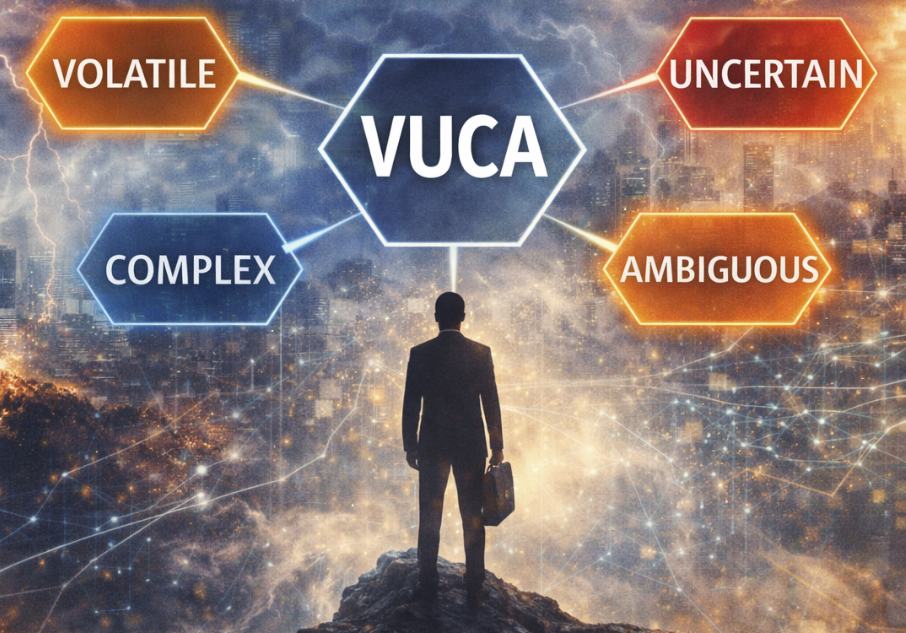
Looking at how the project management landscape is evolving…. and how the broader business environment is shifting in an increasingly VUCA (volatile, uncertain, complex, ambiguous) world… it became clear to me that the next generation of PMO leaders will need a different blend of capabilities.
Not just delivery excellence. Not just methodology mastery. But the ability to lead through change and leverage emerging technologies responsibly.
I therefore made a conscious decision to deepen my expertise in two areas: change leadership and Generative AI.
The first, through formal certification as an APMG Change Management Practitioner, to strengthen my ability to support the human dynamics of transformation.
The second, through executive-level certification in Generative AI, to build the judgment required to guide organizations responsibly through data-driven and technological transformation.
What followed has been a genuinely enriching experience… not simply collecting credentials, but reframing how I think about leadership, transformation, and the future of our profession. Both pathways have reinforced the same insight: technical delivery excellence alone will not be enough for the PMO leader of tomorrow.
Change Management: Mastering the Human Side of Delivery
Every experienced project leader knows this truth:
Projects rarely fail because of methodology. They fail because of misalignment, resistance, unclear purpose, or lack of ownership.
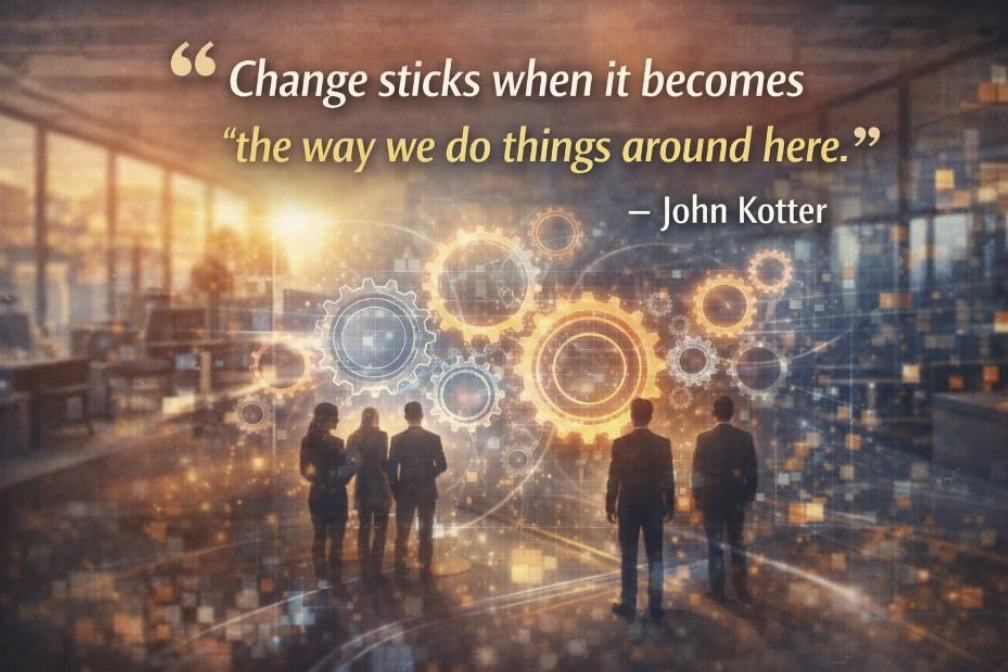
John Kotter put it simply: “Change sticks when it becomes ‘the way we do things around here.”
In many organisations, change management is still treated as a communication plan at the end of delivery.
In my experience, that model is already becoming obsolete.
The most effective PMOs embed change leadership from the start — not as an add-on, but as a core delivery capability.
The most effective PMOs invest in helping teams understand why change is happening, not just what is being delivered. They equip leaders to sponsor change visibly and credibly. They create space for dialogue, learning, and adaptation.
In short: they treat change management as a strategic capability, not a side activity.
GenAI: From Curiosity to Leadership Capability
At the same time, another transformation is underway.
Generative AI is not just another tool in the project manager’s toolkit. Gen AI is reshaping how knowledge work happens: how we plan, analyze, communicate, document, and make decisions.
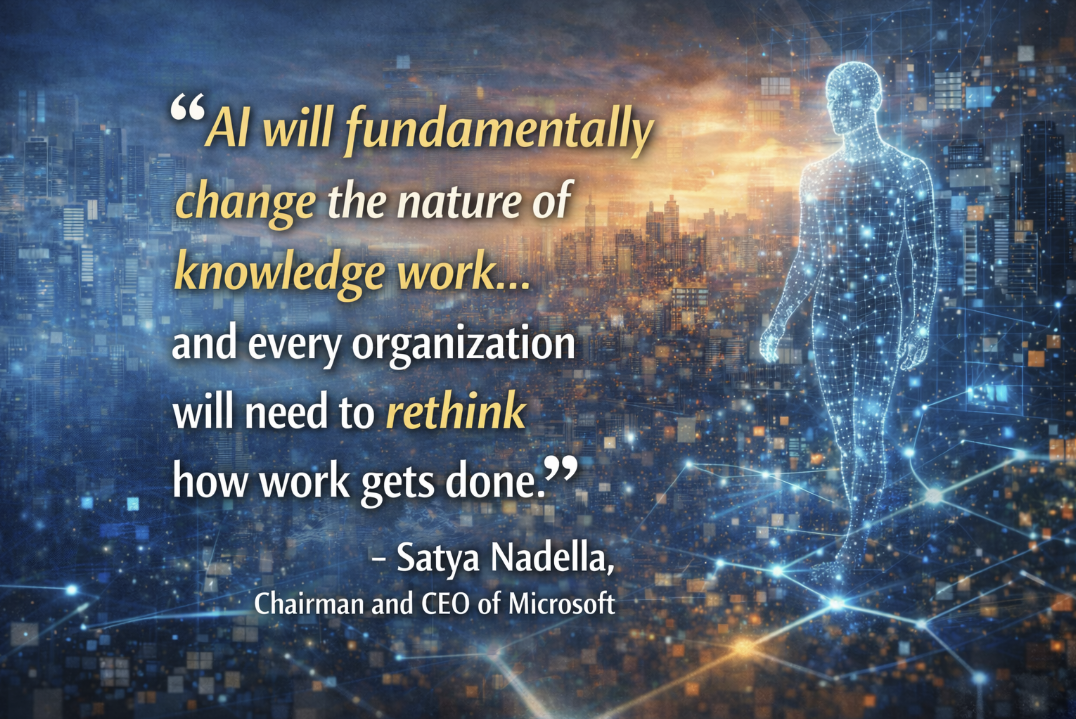
Satya Nadella, Chairman and CEO of Microsoft, described this moment well. He said, “AI will fundamentally change the nature of knowledge work…and every organization will need to rethink how work gets done.”
The real opportunity lies in using GenAI in service of people, not instead of them. The productivity gains it creates should not be used simply to eliminate roles, but to enhance them – and to reimagine possibilities for work that we may never have thought possible before – elevating both human capability and the value delivered to the business.
Reinvesting Productivity Into Capability
One of the most important leadership choices ahead of us is what we do with the productivity gains that technology creates.
If those gains are simply absorbed as efficiency targets, we risk missing the bigger opportunity.
If they are reinvested into upskilling and capability-building, we strengthen our organizations for the long term.
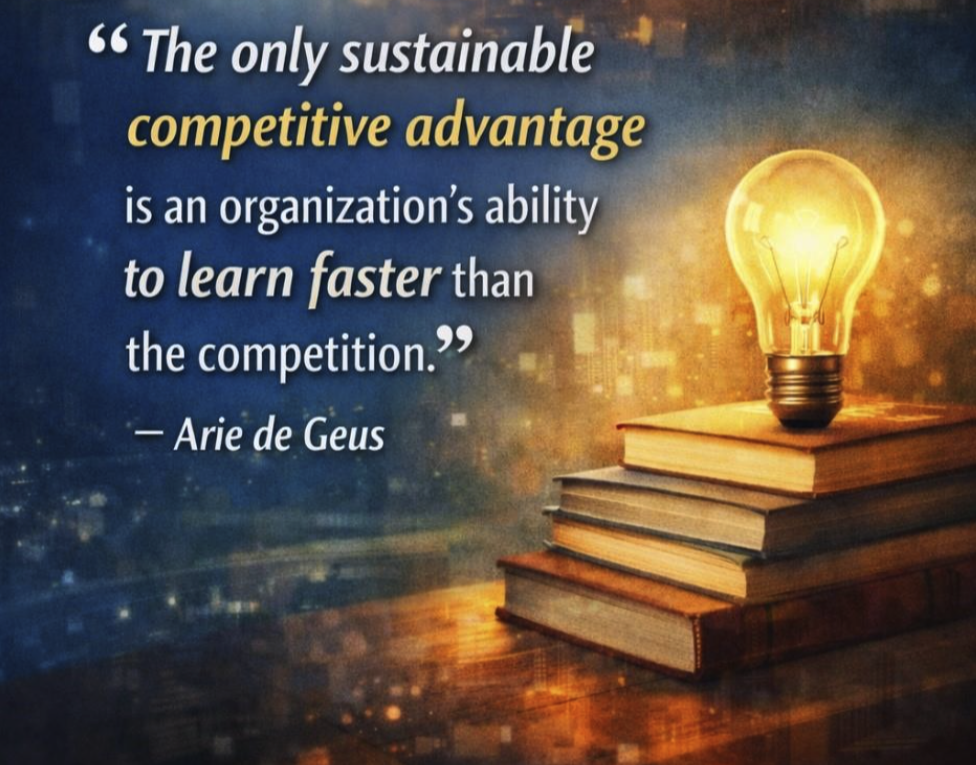
Research on learning organizations and psychological safety – notably by Amy Edmondson – reinforces a well-known insight from Arie de Geus: “The only sustainable competitive advantage is an organization’s ability to learn faster than the competition.”
The PMO Leader of Tomorrow
PMOs sit at the intersection of strategy and execution, technology and people, delivery and transformation. They can help organizations not only deliver change… but become better at changing.
The PMO leader of tomorrow will need to be:
- Fluent in change leadership: able to guide organizations through uncertainty and transition.
- Comfortable with GenAI and emerging technologies: not as a technical specialist, but as an informed leader.
- Focused on building adaptive capability: in themselves, their teams, and their organizations.
Technical project management skills will remain important. But increasingly, they will be augmented and many will be automated by technology.
What will differentiate leaders is their ability to integrate technology with human judgment, structure with empathy, delivery with learning. In that sense, the future of project leadership is not just about delivering projects faster. It is about helping our organizations adapt faster.
For me, this recent learning journey- made possible in part by PMIEF, the Kerzner Award, and the opportunity to continue developing through IIL – has reinforced a simple belief: in a world defined by constant change, the most important capability we can build is the ability to keep learning – and to help others do the same.
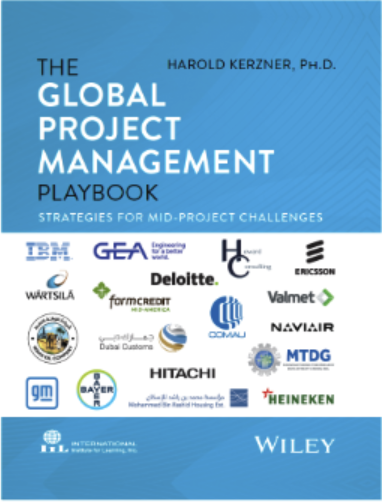
That mindset has been shaped by many mentors and thought leaders whose work guided my early development in project management. Having the opportunity to contribute to Dr. Kerzner’s newest publication, The Global Project Management Playbook – coming out in March 2026, was therefore especially meaningful – a genuine full-circle moment and a reminder of how our profession grows through shared learning across generations.
Kamil Mroz is the 2024 winner of PMIEF Kerzner Award for Project Management.
Learn more about IIL-Endorsed Awards and Scholarships for Project Management.
Kamil Mroz