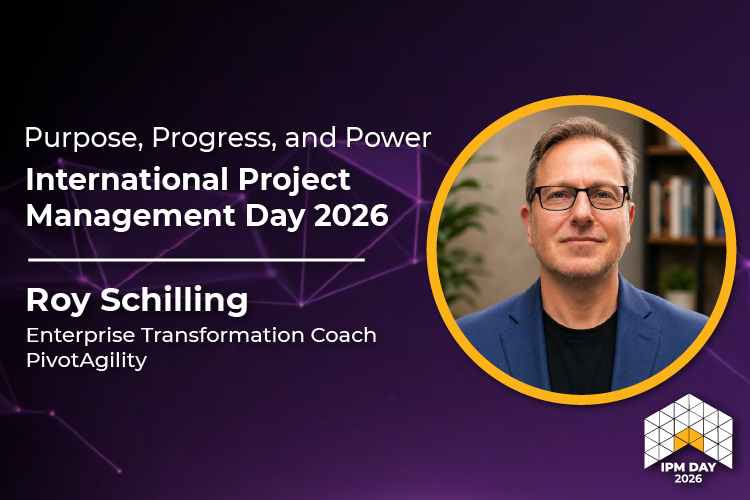
IPM Day 2026 Speaker Spotlight: Roy Schilling
October 8, 2026
Everyone wants AI to help them deliver faster. Roy Schilling, Enterprise Transformation Coach, trainer and founder of PivotAgility, has a warning: faster can make things worse. If your priorities are unclear and your teams are overwhelmed, AI just helps you produce more of the wrong work. In this conversation, Roy explains how Product Thinking helps organizations put new capacity where it matters. Interview by Lori Milhaven, EVP at IIL.
Lori: In your presentation, you talk about how many organizations are “built for yesterday.” What are some signs an organization is still running on old assumptions, even if it considers itself modern?
Roy: One sign is when the language has changed, but the decisions have not. Teams may be using agile practices, new tools, or AI, while still focusing on delivering more features rather than solving customer problems or achieving meaningful results. Work is still pushed from the top, priorities keep accumulating, and success is measured by output rather than results. The organization may look modern on the surface, but its underlying assumptions are still built for a more predictable world.
Lori: Everyone is racing to use AI to increase speed and productivity. But if AI gives organizations more capacity to produce work, what happens when that capacity is added without clearer priorities or better decision-making?
Roy: AI can increase capacity very quickly. The problem is when we assume more capacity automatically creates better results. More capacity does not automatically lead to better outcomes. If priorities are unclear, or the organization is already overloaded, AI may simply help produce more of the wrong work faster, potentially with lower quality as speed outpaces judgment, review, and learning. The question is not just how to use AI, but whether the organization can make better decisions about where that new capacity should go.
Lori: What does Product thinking mean? How does that differ from how project teams work today?
Roy: Product thinking starts with the outcome we are trying to create and keeps asking whether the work is moving us toward it. That creates a stronger connection between strategy and delivery because teams are not just executing a plan. They use evidence to decide what to continue, change, or stop.
Product thinking helps organizations adapt as conditions, evidence, and priorities change. That becomes even more important with AI. If AI gives us more capacity, Product thinking helps us invest that capacity where it can create the most value, rather than simply producing more output.
Project thinking, by comparison, typically organizes work around a defined scope, timeline, budget, and completion point. Product thinking shifts the focus from completing the work to creating the intended outcome.
Lori: Most organizations are great at starting work and terrible at stopping it. How do you use evidence to decide what to keep, change, or stop?
Roy: It starts by changing the conversation from “Are we within and on schedule?” to “Are we producing the result we intended, and does that result still matter to the strategy?” Scope and schedule are useful, but they are not the outcome. Every initiative consumes finite capacity, so continuing the work is an investment decision.
Evidence should help us understand whether we see meaningful movement toward the outcome, whether the underlying assumptions still hold, and whether the work remains aligned to the organization’s priorities. If the evidence changes, the decision should be allowed to change too. Sometimes, the right answer is to continue. Sometimes it is to adjust the approach, redirect capacity, or stop the work altogether.
Lori: As a practical takeaway from your on-demand presentation, what is one simple change that leaders and project teams can make next week to focus on outcomes?
Roy: Start by looking across the projects you are working on, and stop treating each one as a single, indivisible commitment. Ask which parts of the work are helping achieve the organization’s objectives and intended outcomes. Some may be creating value now, while others may no longer be the best use of your capacity.
That shift from “How do we finish the project?” to “Which work will best move the outcome?” is an uncomplicated way to start thinking more like a product organization.
Want to go deeper? Catch Roy’s on-demand video presentation, Built for Yesterday: Why Product Thinking Matter More than Ever, at IPM Day, where he will walk through how to put Product Thinking to work in your organization.
Start today by asking one question: which work will best move the outcome?
Hear Roy and 35+ other speakers on Purpose, Progress and Power. Register for IPM Day 2026 today.
Executive Vice President at International Institute for Learning (IIL)
Our deepest purpose is to enable growth and success of individuals, teams and organizations with long-lasting, high quality learning in a technology-driven world. Lori is honored to have been with IIL over 30 years, and to make it her mission to focus on continuous improvement, client driven success and to go above and beyond to meet expectations.

Roy Schilling is an Enterprise Transformation Coach, trainer, and founder of PivotAgility with more than 30 years of experience across technology, product development, delivery, leadership, and organizational change. He has worked across many industries, helping organizations improve adaptability, make better decisions, and connect work and investment to meaningful outcomes. His current work explores how AI is changing the speed and economics of work, exposing organizational assumptions built for a different environment and increasing the importance of context, judgment, and adaptability.
Follow Roy Schilling on LinkedIn: https://www.linkedin.com/in/royschilling/