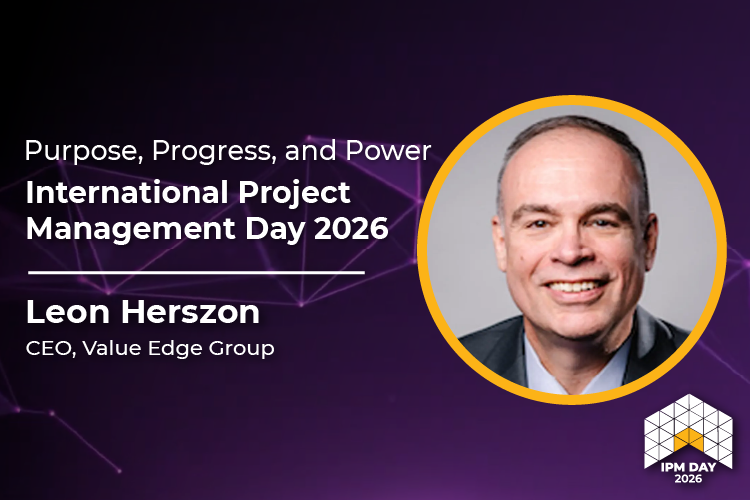
IPM Day Speaker Spotlight: Leon Herszon
October 12, 2026
“AI will replace everyone.” “AI is just a tool.” Both are wrong. Dr. Leon Herzon, CEO of Value Edge Group, argues the real disruption isn’t about job titles at all. It’s about the work inside them, and how fast expectations are shifting. We asked Leon why critical thinking is the most valuable skill in your toolkit ahead of his session, AI is Here. The Future is Leading Projects in the In-Between Times at IPM Day 2026. Interview by Lori Milhaven, EVP at IIL.
Lori: You call this as the “in-between times”, when AI is changing how project work gets done, but accountability, judgment and human oversight still matter. What does this transition mean for project managers?
Leon: The in-between period is when technology has already changed, but organizations and people have not fully caught up. AI is evolving very quickly, but organizations are moving more slowly because processes, governance, culture, legacy systems, and people need more time to build trust and change the way they work.
For a project manager, that creates an interesting tension. You are expected to use AI to move faster and improve productivity, while many of the rules, processes, roles, and expectations around you were designed for a different environment. At the same time, you are leading others through the same uncertainty you are experiencing yourself.
My point is that we should not spend too much energy trying to predict what the future will look like. We need to learn how to lead effectively during the transition.
Lori: We see headlines swing between “AI will replace everyone” and “it is just a tool.” Where is the answer and why do most people get it wrong?
Leon: Both extremes miss what is happening. I do not believe AI will suddenly eliminate entire professions, but calling it “just another tool” also understates the magnitude of the change.
The more useful distinction is between jobs and work. Jobs may remain, but the tasks inside those jobs are already changing.
AI can draft, summarize, analyze patterns, generate alternatives, and perform many administrative activities much faster than we can. But other parts of the job, such as judgment, negotiation, trust, leadership, ethics, and accountability, remain fundamentally human responsibilities.
So, my view is simple: not every job disappears, but nearly every job changes.
The mistake is focusing on whether your job title will still exist. The better question is: How will AI change what people expect from someone in my profession? That is where the real disruption will occur.
Lori: What is a skill or habit that used to be optional for project managers but is now becoming make-or-break in the AI era?
Leon: I would say critical evaluation and verification. Project managers have always needed critical thinking, but AI makes it much more important because we can now produce credible-looking answers, analyses, plans, and recommendations almost instantly.
The danger is that speed can create false confidence. If AI gives me a polished answer in ten seconds, I still need to ask: Is it correct? What assumptions is it making? What context is missing? What could be wrong? What are the consequences if I act on it?
One of the questions I encourage project managers to ask themselves is: Am I using my critical thinking skills? Did I challenge the AI output?
The new habit is not simply learning how to get answers from AI. It is learning how to challenge those answers.
Lori: Drawing on your experience in education, consulting, and organizational practice, are there any historical shifts that can help us understand what to expect as AI changes the way we work?
Leon: I look at previous technological shifts, from steam and electricity to personal computers, the internet, and smartphones. The technologies were different, but the pattern was similar: disruption, adaptation, and eventually transformation. Industries and jobs changed, and the people and organizations that adapted learned to work differently.
History also teaches us that change follows a process. Technology moves first, organizations follow, and people often take longer as they build experience, confidence, and trust.
History cannot tell us exactly what AI will bring, but it can help us understand the process. Over time, AI will become embedded in how we work, much like the internet is today. We will no longer think of “using AI” as a separate activity. AI will simply become embedded in our work.
Lori: As AI becomes embedded in our work, you can delegate tasks, but you still own the decisions and outcomes. What’s the biggest mistake you can make as a project manager when relying on AI?
Leon: The biggest mistake is confusing delegating a task with delegating accountability. AI can generate options, analyze information, recommend a course of action, or even carry parts of a workflow. This is exciting, but if I am the project leader, I am still responsible for the decision and its consequences.
AI cannot sit in front of a client, the executive team, an employee, or the board and take accountability for what happened.
This is a distinction I emphasize: AI produces options. You make the decisions. You must evaluate, verify, approve and be accountable for the outcome.
As AI becomes more capable, your judgment becomes more important. Your value as a project manager increasingly lies in understanding context, seeing the bigger picture, challenging assumptions, managing relationships, making difficult decisions, and owning the results.
That is why one of my principles for this period is very simple: Verify everything. Never accept AI output at face value.
Stop asking whether your role will survive. Start asking how you can evolve to meet your stakeholders need and thrive in an AI-driven world. Dr. Leon Herszon will explore this shift at IPM Day 2026 on November 5, with insights to help you navigate change and shape the future of your role.
Join thousands of project professionals worldwide under this year’s theme, Purpose, Progress, and Power. See you online at IPM Day 2026!
Executive Vice President at International Institute for Learning (IIL)
Our deepest purpose is to enable growth and success of individuals, teams and organizations with long-lasting, high quality learning in a technology-driven world. Lori is honored to have been with IIL over 30 years, and to make it her mission to focus on continuous improvement, client driven success and to go above and beyond to meet expectations.

Dr. Leon Herszon
Dr. Leon Herszon, MSc, PhD, PMP, CSM, CSPO, DASSM, is a highly accomplished, versatile, and respected executive with over 30 years of extensive achievements within diverse environments utilizing exemplary management, analytical, organizational, and people skills. He has experience leading teams to improve performance and manage business transformation focused on agility, transparency, teamwork, experimentation, and innovation. Dr. Herszon’s doctoral research explored factors that contribute to project complexity and proposed a model to manage complexity.
Dr. Herszon performed roles as executive and managing director, Chief Agility Officer, entrepreneur, portfolio, program and project director, business transformation leader, corporate educator, Head of IIL Consulting, and is currently the CEO & President of Value Edge Group. He is also an Adjunct Professor at the prestigious Rutgers Business School. Dr. Herszon can communicate in English, French, Portuguese, German, and Spanish, and is also a several times Ironman triathlon finisher.