
Summary
Capability fortitude is a composite of four traits dynamic prioritization, information-seeking behavior, resilience, and compartmentalization that separate high-performing project managers from the rest. It’s a term Dr. Tresia Eaves coined after 30 years in IT leadership and the US Air Force, and it’s the foundation of her forthcoming book. In this piece, she breaks down each trait, backed by research from Angela Duckworth on grit and Dr. Brenda Dervin on information-seeking behavior, and shows exactly how they show up under real project pressure.
As my career evolves, I have become increasingly passionate about giving back to the project management profession by helping others build the skills they need to succeed. In this article, I explore several of the characteristics that I believe enable project managers to deliver above and beyond project leadership and develop what I call capability fortitude.
We start with four essential traits: dynamic prioritization, information-seeking behavior, resilience, and compartmentalization. As I seek to understand what sets high-performing project managers apart, I will share additional characteristics that contribute to capability fortitude. This work will form the foundation of my forthcoming book, The Above and Beyond Leadership Almanac for Project Managers.
Dynamic Prioritization
One of the most valuable concepts I learned in the military is dynamic prioritization: the ability to establish clear priorities while remaining ready to adjust as circumstances change. Plans are created in a “happy path” environment and adapted when conditions change. Planning in a safe environment works well until the enemy does something unexpected. In the military, we train for every scenario, most often in a happy path environment and sometimes in simulations where the enemy is testing us.
When a situation occurs whereby you must immediately change your priorities based on the unexpected, you start to see pathways in your mind that lead to certain destinations. You play out multiple scenarios instantaneously and choose the best path to take. You may not even be aware that this is what you are doing but, in the moment, your scenario of exercises reduce risk and help you assess options.
In a project situation, although not likely a life-or-death issue, a project manager is playing out many scenarios when faced with obstacles too. For example, in a particular project, your priority might be to order hardware for a disaster recovery site your team is establishing. Then a global pandemic hits, and there is a supply constraint or shortage of parts causing you to rethink your schedule and your plan. It takes resolve, gumption, and grit to push through these types of setbacks.
Through my work studying the project management profession, I find dynamic prioritization critical to our ongoing success. We have all heard that humans are not wired for multitasking, and I believe that is true. Instead of trying to do everything at once, what you can do is flex your focus on priorities as needed.
This capability to refocus is part of dynamic prioritization. It is your ability to adjust as needed in the heat of battle. We do this in our everyday lives as well: a sick child might require us to put our work aside until they are well, a large project at work may require extra hours to move over the finish line, and many other examples.
A temporary shift in our focus does not mean permanence to the shifting priorities. Rather, it is a temporary need to keep our lives balanced. Research in cognitive psychology supports this idea, demonstrating that what we perceive as multitasking is rapid task-switching, which reduces efficiency and increases error rates (Rubinstein, Meyer, & Evans, 2001). For project managers, this reinforces the importance of intentional prioritization rather than the illusion of doing everything at once.
The capability to adjust quickly when things change around your original assumptions of a project, is only one of a set of traits that make up capability fortitude. It is a natural part of risk management, and usually, people stop with the definition of this skill with that label. There are several of these behaviors that make project managers successful, and I would guess many have not been considered, taking them for granted or lumping them into other traits. If we examine these specific behaviors and learn how to teach them, we will propagate grit in our profession.
Angela Duckworth’s foundational work on grit defines grit as “perseverance and passion for long-term goals”, and her research found that grit is a stronger predictor of success than IQ or talent across multiple high-performance environments (Duckworth, Peterson, Matthews, & Kelly, 2007). Translating this finding into project management means that hiring and developing for grit may yield better project outcomes than hiring solely for technical expertise.
Information-Seeking Behavior
The second skill included in my suite of capability fortitude traits is the information seeking behavior of project managers. How do we, as project managers, find the answers or information we need to keep a project moving?
Google does not always have the answer, and neither might Claude nor any artificial intelligence (AI) tool we may use. Sometimes, we must dig, infer, and integrate data to come up with an answer. The push to keep looking for the information we need is part of our grit toward being the best we can in our profession.
I use Dr. Brenda Dervin’s methodology on information-seeking behavior to apply to anyone facing uncertainty or change. Dr. Dervin’s sense-making metaphor (illustrated in her drawing below) defines the stages that lead you through an information-seeking experience.
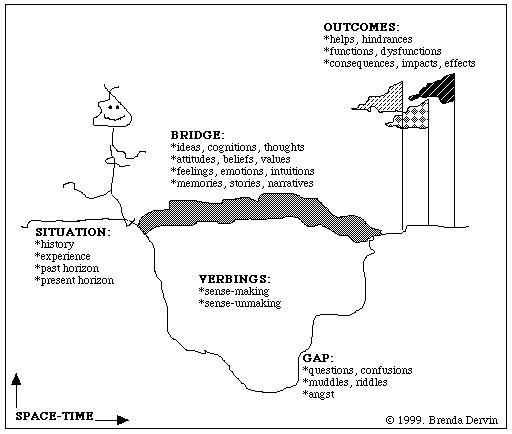
Dr. Brenda Dervin’s original artwork of the sense-making metaphor
Source: informationr.net, 2023
To illustrate how Dr. Dervin’s sense-making metaphor applies to project management, consider the following example of a project manager (PM) developing AI skills:
- Situation – Recognizing a gap in my skills, I realized that I need to strengthen my use of AI as a project manager.
- Bridge – Curiosity leads to my exploration of information and searching PMI.org, IIL.com, and my local PMI chapter for ways to learn more.
- Verbings – Collection of information based on reviews, perceived credibility, and access, I choose the sources of information I will use.
- Outcomes – Consequences of my information-seeking leads me to take the training and learn what I need to use AI in my job.
Dr. Dervin’s sense-making methodology is particularly relevant in project management because projects are, by definition, unique undertakings with incomplete information. The PM who can systematically close information gaps adds disproportionate value compared to one who waits for information to be delivered.
This proactive search aligns with what some researchers describe as “epistemic curiosity”, a hunger for knowledge that drives sustained inquiry even when answers are elusive (Litman, 2005). PMs who cultivate epistemic curiosity tend to ask better stakeholder questions, surface hidden risks earlier, and synthesize fragmented data into actionable plans.
Resilience
The third skill I include in my suite of traits that make up a PM’s capability fortitude is resilience. Not just the standard definition, but the intestinal fortitude to push through the negative feedback and the obstacles that block us along our path to accomplishing our role as a PM.
Resilience in this context is more than bouncing back from failure. It is the daily, often unseen, work of absorbing setbacks without losing momentum. As The Cult lyric reminds us, “The world drags me down”, and yet the gritty PM keeps moving forward.
Resilience research in organizational psychology suggests that resilient professionals share three characteristics: a staunch acceptance of reality, a deep belief that life is meaningful, and an uncanny ability to improvise (Coutu, 2002). Each of these maps directly to project management.
Accepting reality means acknowledging when a schedule is slipping rather than hiding it from sponsors. Finding meaning means connecting daily project tasks to a larger organizational mission. Improvisation, much like dynamic prioritization, is the ability to make do with the resources at hand when the original plan is no longer viable. Resourcefulness is another part of resilience, the ability to substitute one thing for another or look for replacements when the original plan goes off the rails.
Resilience can also be developed. The Project Management Institute has increasingly emphasized power skills, including resilience, adaptability, and emotional intelligence, as essential complements to technical and business acumen, noting that organizations that prioritize these skills outperform peers in benefits realization and project success (Project Management Institute, 2023). This evidence reinforces my argument that capability fortitude, that bundle of dynamic prioritization, information-seeking behavior, and resilience, deserves explicit attention in project management training programs rather than being treated as a happy byproduct of experience.
Compartmentalization
One of my best friends, Kelli, spent 33 years as a GI nurse at Children’s Medical Center in Texas, caring for children who needed GI transplants and had major health challenges. She taught me a lesson: your stuff stops at the door of your work. Whatever is happening at home, whether it is an argument or something weighing on your mind, gets put away when you walk through that door to do important work. In those moments, you must be fully present.
As a wife, mom, daughter, friend, and special other to so many, Kelli did not mean those roles became less important. Instead, she carefully organized her life and put contingency plans in place, so her family’s needs would be met during her 12-hour shifts.
I had a hard time doing this in the military. I had to leave my baby when she was only 8 weeks old and it was hard. I would drive 12 hours each way, every other weekend, just to spend 24 hours with her and my husband. I did this for 5 months and it was brutal. But my commitment to the Air Force, just for that period, had to come first, as it provided for us the rest of our lives. When people talk about how our military and their families sacrifice, this is only a part of what they are describing.
As I have gotten older, I have been able to have more control over my compartmentalization skills. My kids are all grown and I still worry about them but it is a lot easier when they are not as dependent on mom.
You will work with people at all stages of life, so it helps to take a dualistic approach to priorities, when possible. For example, if my child is graduating, that will always take priority over an awards event or conference. Family comes before work or social engagements.
Good planning helps avoid many scheduling conflicts, but it is inevitable that we will have to choose sometimes. In your work and when you can, compartmentalization is a way to focus on what you need for short periods of time. It does not change your overall priorities in life.
Conclusion
Capability fortitude is not a single trait but a composite of behaviors that together produce gritty, effective project managers.
Dynamic prioritization helps PMs pivot when assumptions break. Information-seeking behavior, guided by frameworks like Dervin’s sense-making metaphor helps PMs close knowledge gaps under uncertainty. Resilience powers the long arc of delivery despite obstacles. Finally, the skill of proper compartmentalization is a way to really focus on a project for short periods of time.
By naming these behaviors, teaching them deliberately, emulating them in the workplace and rewarding them in practice, our profession can move grit from an admired but vague quality into a developable, measurable competency.
References
Want to see more on this topic? Watch Dr. Tresia Eaves’ presentation, Wisdom and Project Managers, at IPM Day 2026, the most anticipated online conference of the year. Register today!
Dr. Tresia Eaves, PMP, SAFe Agilist, CSM, has 30 years of technology consulting and information technology leadership experience. She is also an author, adjunct professor, public speaker, and proud veteran of the US Air Force. She earned her doctorate from the University of North Texas, and her area of study was Information Science. Dr. Eaves is a published author with her book, “Above and Beyond: The Secrets of Outstanding Project Leadership” published in 2014 by IIL and multiple other articles in professional and academic journals. She is the founder and owner of Variant Enterprises, LLC where she consults with commercial and government organizations using her world class project management skills.
Reach out to Dr. Eaves at DrTresiaEaves@variantenterprisesllc.com, or connect with her on LinkedIn at: https://www.linkedin.com/in/tresia-eaves-phd-agilist-pmp/