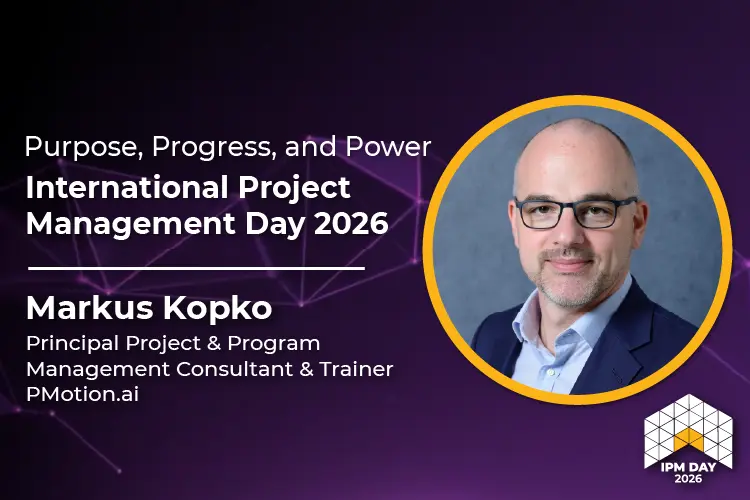
IPM Day Speaker Spotlights: Markus Kopko
By Lori Milhaven
September 21, 2026
Ask most people how they use AI and they will show you a folder of saved prompts.
Markus Kopko sees that as a starting point. In his four-step model, saved prompts represent level 2, where AI can help, but still requires constant briefing, can produce inconsistent output, and often creates work that no one else can easily pick up and use.
That sets up a conversation worth having. I asked Markus Kopko to walk me through how project professionals can move beyond prompts and turn AI into practical, usable tools that support recurring work.
Read the conversation with Markus Kopko, PMotion.ai and On-Demand Presenter at IPM Day 2026, and Lori Milhaven, EVP at IIL. Markus will be speaking on From Prompts to PM Power Tools: Build Custom AI Tools for Recurring Project Work.
Lori: What is the difference between using AI and building an AI tool, and why does that determine whether you are saving five minutes or five hours a week?
Markus: Using AI means you open a chat, explain your project, paste your template, describe your standards, and then get an answer. Next week you will do all of that again. The assistant remembers nothing, so the effort never goes down. You save a few minutes on the writing and lose them again on the briefing.
Building a tool means you do that briefing once. The instructions, your templates and your standards live inside the tool. From then on, you only bring the project specifics. Every run is faster than the last, the output looks the same across projects, and you can hand the tool to a colleague.
That is where the hours come from. Prompts do not compound. Tools do. The saving is not in one clever answer. It is in all the recurring work you never have to brief again.
Lori: You talk about an AI maturity model that goes from Prompt to Context-Aware Workspace. Where do most project managers get stuck, and what is it costing them by staying there?
Markus: The model has four levels: the prompt, the saved prompt, the custom tool, and the context-aware project workspace. Most project managers I work with sit at level two. They have a collection of good prompts in a note somewhere and they paste them in when needed.
That feels productive, and it is a real step up. But the wording is saved, the context is not. You still supply the background, the standards, and the data by hand every single time. The result still depends on how well you briefed the assistant that day.
The cost is threefold. You pay the briefing effort again. Quality drifts between projects because the rules live in your head, not in the tool. Nothing you build can be shared with your team, because a prompt in a personal note is not an asset. The jump to level three is small in effort and large in return.
Lori: Walk us through what happens when a Custom GPT or Claude Project actually 'remembers' a Risk Register from three months ago. What can it catch that a fresh prompt never would?
Markus: Risk work is not one and done. You assess at the start and then come back to it cycle after cycle. The value is in the through-line, and a fresh prompt has none. It meets your project for the first time, every time.
In the IPM Day session, I show a risk tool that holds the exports of two earlier assessment cycles as knowledge. When I run cycle three, it compares against history and labels every risk as new, recurring, escalating, or closing. It flags that a vendor delay risk went from medium to high. It points out that scope creep has shown up in every single cycle, which calls for a structural answer, not another one-off mitigation. It also spots a new data quality risk entering straight at high.
None of those needs a person to hold three months of history in their head. The tool turns a stack of separate assessments into one continuous view of how your risk profile is moving.
Lori: If someone builds only one custom AI tool this month, which project management process should it be and what is the fastest path to getting it right?
Lori: Custom GPTs, Gems, Claude Projects, and Superagents all promise the same thing. What is the one platform difference that matters for a project management team?
Markus: The biggest difference is not the feature list. It is where your data is allowed to live and how your organization can govern it. For a project management that matters because charters, risk registers, stakeholder information, and other project data can be sensitive. Your organization’s data and security requirements may narrow the platform choices before capability even comes into the conversation.
After that, go where your team already works. Gems make sense if you live in Google Workspace. Custom GPTs bring a broad ecosystem. Claude Projects are strong for document-heavy work and long context. Agent platforms go furthest but also carry the heaviest governance load. Adoption beats capability every time.
The good news is that the method is platform-agnostic. Every tool on every platform has the same three parts: instructions, knowledge, and context. Learn those three and switching platforms later costs you very little. Whatever you choose, keep a human in the loop, know what you upload, and version your instructions. That is the part of the build you cannot skip.
Lori: Thank you, Markus, for a conversation that moves us from clever prompts to practical tools that can deliver lasting value. For our readers and attendees of IPM Day, here is a question to take with you: What do you find yourself re-explaining to AI every week?
One conversation is just the start. International Project Management Day 2026 brings you 35+ presenters, including Markus Kopko, with guidance on the skills you need today. Online. From IIL.
Register Today: https://www.shop.iil.com/product/international-project-management-day-2026/
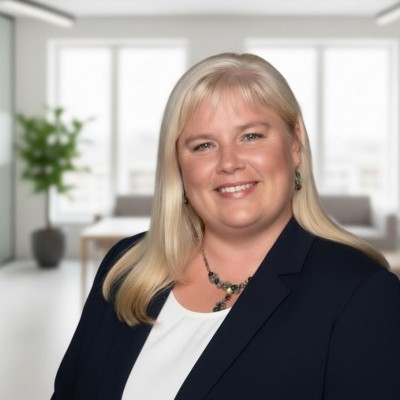
Executive Vice President at International Institute for Learning (IIL)
Our deepest purpose is to enable growth and success of individuals, teams and organizations with long-lasting, high quality learning in a technology-driven world. Lori is honored to have been with IIL over 30 years, and to make it her mission to focus on continuous improvement, client driven success and to go above and beyond to meet expectations.
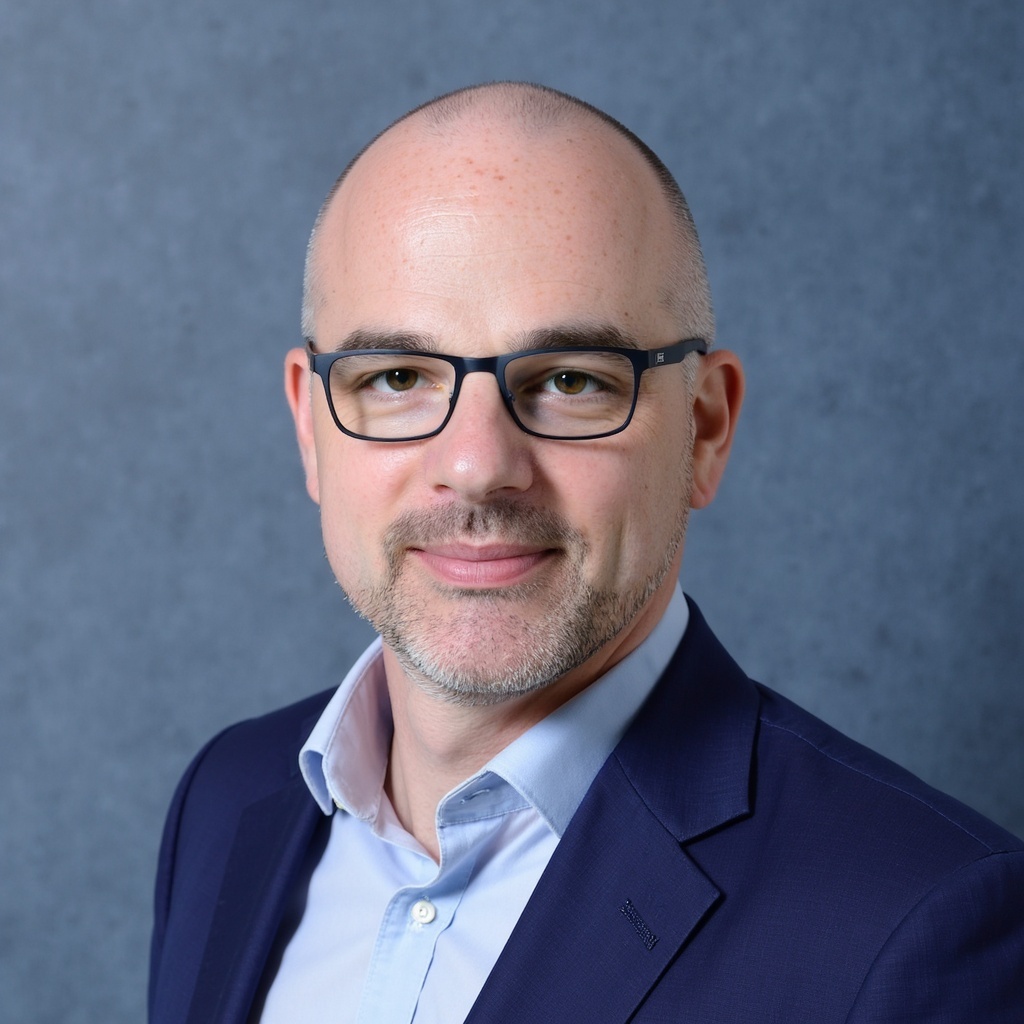
Markus Kopko is a strategic project management and AI transformation expert with 25+ years of experience in project, program, and portfolio management. He is a member of the Core Development Team for the PMI Standard on AI in Project, Program, and Portfolio Management and served on the PMI Review Team for the PMBOK® Guide 7th Edition.
As founder of PMotion.ai and The PM AI Coach, Markus helps project professionals integrate AI into their daily practice through structured frameworks and governance-first approaches. He focuses on the governance gap that traditional PM methods leave open once AI introduces model drift, explainability requirements, and probabilistic outcomes.
He develops and delivers cohort-based coaching programs in AI-focused PM practice, including dedicated PMI-CPMAI® certification preparation. He is also an affiliate partner and trainer for the International Institute for Learning (IIL), delivering PMI certification courses and AI-focused training to PM professionals.
Markus holds the PMP®, PgMP®, and PMI-CPMAI® certifications from PMI, as well as the C-AITL certification from USAII.