
Interview with Dr. Ed Hoffman and Joti Balani
Closing Live Day Keynote Presenters, IPM Day 2026
Posted August 20, 2026
Every organization talking about AI failure is asking the wrong question. They are asking, “which tool?” Dr. Ed Hoffman spent 33 years at NASA learning the only question that matters: “Do you understand what you’re governing?” Joti Balani has spent the last three years watching that same question stall C-suites cold because most of them have never had to answer it.
95% of enterprise AI investment shows zero measurable ROI. Not because the models are bad. Because the judgment was never built. This is that conversation.
Key Takeaways
- AI didn’t cause enterprise failure: it revealed 40 years of governance gaps that already existed inside organizations.
- AI added “basically zero” to US GDP growth in 2025 — about 0.2 of its 2.2 percentage points (Goldman Sachs, Feb 2026).
- 90% of executives report no AI productivity impact, despite projecting a 1.4% gain (NBER, Feb 2026).
- Manager engagement has fallen from 31% to 22% since 2022, the steepest drop on record (Gallup, 2026), because managers are held accountable for AI outcomes without governance authority.
- The single strongest variable in AI transformation success: one named, accountable leader, not a committee (Gallup, Q1 2026).
- The fix isn’t a better tool. It’s answering one question before the budget is approved: what problem are you actually trying to solve?
Why Is AI Failing to Deliver ROI for 95% of Enterprises?
Short answer: It’s a 40-year governance gap, not a technology problem.
Dr. Ed Hoffman: For 33 years at NASA, governance failure was not a financial risk. It was a human one. The standard we held was simple: you do not govern what you have not understood. Not as policy. As personal standard. What the independent data now confirms is that this was never an AI problem. Organizations spent 40 years optimizing for process compliance rather than learning. When AI arrived, people defaulted to deploying it the way they deployed the last system: tool-first, top-down, with no shared understanding of the mission it serves. AI did not create the judgment gap. It revealed it.
Independent sources:
- MIT Media Lab, The GenAI Divide: State of AI in Business 2025 — n=2,400 enterprises, 15 industries, 18 months. 95% report zero measurable ROI on AI investment despite $35–40B spent; only 5% of custom enterprise AI tools reach production. forbes.com
- Goldman Sachs (Jan Hatzius, Atlantic Council, Feb 2026) — AI investment added “basically zero” to US GDP growth in 2025, about 0.2 of its 2.2 percentage points. inc.com
- NBER, February 2026 — n=6,000 global executives. 90% report no impact of AI on workplace productivity, while projecting a 1.4% productivity gain. nber.org/papers/w34836
Why Are Managers the Most Stressed Layer in the AI-Driven Workplace?
Short answer: They’re accountable for AI outcomes they were never given authority to govern.
Joti Balani: I have sat in these rooms in regulated financial services, in healthcare, in government. The pattern is consistent. The tool was chosen before the outcome was defined. The workflow it was meant to change was never mapped. The practitioners executing the initiative know this. They cannot halt it. They are accountable for delivery without the conditions for delivery having been built above them. Gallup now confirms what those practitioners already felt: they are the most emotionally depleted layer in the organization. Not because they are failing at AI. Because they were set up without a governance framework and then held accountable for the result.
Independent sources:
- Gallup, State of the Global Workplace 2026 — Global manager engagement fell from 31% (2022) to 22% (2025), the steepest recorded decline. Managers report higher stress (+7pts), anger (+12pts), sadness (+11pts), and loneliness (+10pts) than individual contributors. Low engagement costs the global economy $10 trillion annually. gallup.com/workplace/349484
- Harvard Business Review / Oxford-Babson Study, June 2026 — AI creates role elevation above and below the manager, not for them; managers must now validate AI outputs, catch “workslop,” coach AI use, and hold quality standards with no added support. hbr.org/2026/06
- Upwork Research Institute, 2024 — n=2,500. 77% say AI added to their workload; 47% don’t know how to achieve the productivity gains leadership expects. investors.upwork.com
Why Does "One Accountable Leader" Outperform Committee-Led AI Governance?
Short answer: Committees endorse. Leaders govern. And accountability disappears without a named owner.
Dr. Ed Hoffman: At NASA the rule was: not a committee, a person. One named human being, accountable, who has personally understood what they are governing. Committees endorse. Leaders govern. When governance is distributed across a committee, accountability disappears. When the outcome is not precisely defined before the technology is deployed, no one is wrong when it fails. And when the leader has not personally done the work, they are not governing — they are endorsing. Those are different jobs. One of them changes organizations.
Joti Balani: My team includes practitioners who ran risk management at major financial institutions, held C-level roles at global banks, and built trading infrastructure for investment banking operations. What they saw from inside those institutions is that governance frameworks built by people who have never operated under the weight of a regulatory consent order, a board audit, or a mission-critical system failure are frameworks that do not hold. The approach we’re presenting today was built by people who held. That is the difference.
Independent sources:
- Gallup, Q1 2026 US Workforce Survey — Employees whose manager actively champions AI adoption are 8.7x more likely to say AI has transformed how work gets done. Named personal accountability — not a committee — is the single strongest variable in AI transformation outcomes. gallup.com/indicator-artificial-intelligence
- DDI, Global Leadership Forecast 2025 — n=10,000+ leaders, 50 countries. 71% report significantly more stress than a year prior; 40% are actively considering leaving their roles. ddi.com/global-leadership-forecast-2025
What One Question Stops Every C-Suite Leader Cold?
Short answer: “What problem are you actually trying to solve?” asked before the technology is chosen.
Joti Balani: Every C-suite leader I have asked that question has gone quiet. Everyone. They approved the budget. They endorsed the platform. They announced the initiative. But they did not start with a precisely defined financial or mission outcome before the technology was chosen. The silence is not embarrassment. It is recognition. The question reveals that the governance architecture was never built.
For the practitioners in this room: your job after today is not to wait for your leader to answer it. Your job is to be the person who already knows how to answer it for your own domain and who has the evidence and the language to bring it upward.
Independent sources:
- NBER, February 2026 — n=6,000 executives. The gap between executive expectation (1.4% projected productivity gain) and measured outcome (90% reporting zero impact) is the governance measurement gap: organizations measure tool deployment and adoption, not whether work actually changed. nber.org/papers/w34836
- MIT Media Lab, 2025 — The most common cause of AI failure: trying to solve everything at once, deploying AI into the wrong areas, and measuring deployment rather than outcome. Failures hinge less on model quality than on a system’s inability to integrate with workflows. forbes.com
What Governance Skill Are Practitioners Missing, and How Do You Build It?
Short answer: Governance judgment: knowing which tool fits which decision, and naming the outcome before the budget is approved.
Dr. Ed Hoffman: The organizations that navigate this intact will be the ones where someone at every level was willing to ask the right question first. You now know what that question is. You also know where to find the people who built the approach from the inside.
Joti Balani: The skill this audience is not being trained on is governance judgment. Not tool competency judgment. Which tool fits which decision. When a human must stay in the loop, and why. How to name the outcome before the budget is approved. How to build the financial case before the technology is chosen. How to ask the one question that surfaces the governance gap without requiring a project halt. We built this approach at Columbia because graduate students who will advise C-suites needed it. We’re presenting it today because the practitioners in this room need it too. Reach out after today.
Independent sources:
- Gallup, Q1 2026 US Workforce Survey — Only 12% of employees in AI-implemented organizations strongly agree AI has transformed how work gets done. gallup.com/indicator-artificial-intelligence
- BetterUp Labs / Stanford Social Media Lab, HBR September 2025 — n=1,150. “Workslop” (AI output that looks professional but lacks substance) reached 41% of workers in the past month, averaging 1hr 56min to resolve per incident — costing a 10,000-person firm $9M annually. hbr.org/2025/09
Closing Thoughts from Lori Milhaven, EVP Strategic Projects, IIL
The uncomfortable truth here isn’t about AI. It’s about governance and sovereignty that never got built before the technology showed up. Ed and Joti are reframing the thinking of our next generation to ask the right question first, not after the budget’s spent.
If your organization is still measuring adoption instead of outcomes, the gap they are describing is already yours. The question is who’s willing to ask it out loud?
My thanks to Ed and Joti for a conversation that let no one off easy, including me. This is the work IIL exists to do, and I’m grateful to do it alongside leaders who have actually held the weight of getting governance right.
Want a preview? Dr. Ed Hoffman and Joti Balani will lead a live free webinar on September 9, 2026!
The 88% Problem: Why Your AI Rollout Is Not Changing How Work Gets Done
Register Today!
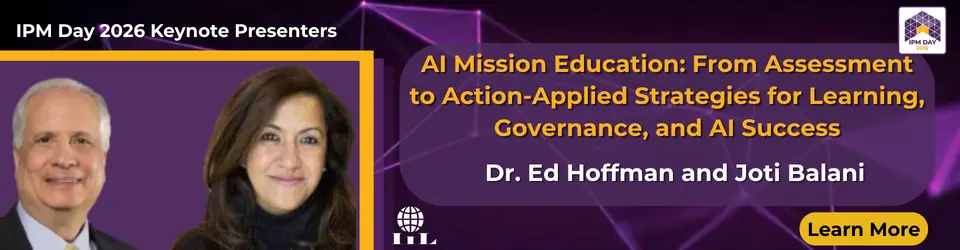
Dr. Hoffman is CEO of Knowledge Strategies, LLC, providing research, education, and consulting in support of organizational performance. He serves as a Strategic Advisor to the Project Management Institute and as a Senior Lecturer in the Master of Science in Information and Knowledge Strategy program at Columbia University’s School of Professional Studies.
After 33 years, Dr. Hoffman retired from NASA as a senior executive. He was appointed NASA’s first Chief Knowledge Officer in 2011 and was the founding director of the NASA Academy of Program/Project and Engineering Leadership (APPEL), a role he held for over 20 years. He received the NASA Outstanding Leadership Medal in 2010.
Dr. Hoffman is co-author of The Smart Mission: NASA’s Lessons for Managing Knowledge, People and Projects (MIT Press, 2022), winner of the Axiom Business Book Award, and co-author of Shared Voyage: Learning and Unlearning from Remarkable Projects (NASA, 2005).
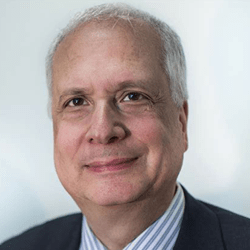
Joti Balani is Founder & CEO of Freshriver.ai. Her work starts with the question most AI programs skip: what is the precise financial outcome this organization needs – and is the AI being built to answer that question, or a different one? She has sat on both sides of that question, including as a member of a corporate Board Audit Committee during a period of significant M&A, and leading GenAI strategy and delivery inside a major regulated healthcare organization through 2025.
She has applied the precise money question discipline across regulated financial institutions, commercial real estate, mortgage technology, and federal contracting, each time defining the financial outcome before the technology was chosen, to a standard that passes CFO and board scrutiny.
Columbia University SPS AI Advisor & Speaker · PMI Global Executive Council, Nashville (2024) · PMI AI Essentials Guide contributor (2024) · IIL International Project Management Day: AI in Project Management (2024) · NSA/NSF AI GenCyber Camp, Indiana University of Pennsylvania (2023, 2024) · Trenton Computer Festival, The College of New Jersey (2024) · Innovate100 NJ 2025 · CES (2023) · FinTech Connect (2023).

Contributing Author to PMI’s ebook, Leadership that Lasts, June 2026.
Chapter, Principled AI Profit: Leveraging AI Ethics and Governance as a Transformative Competitive Advantage.